


Download
Items of Interests
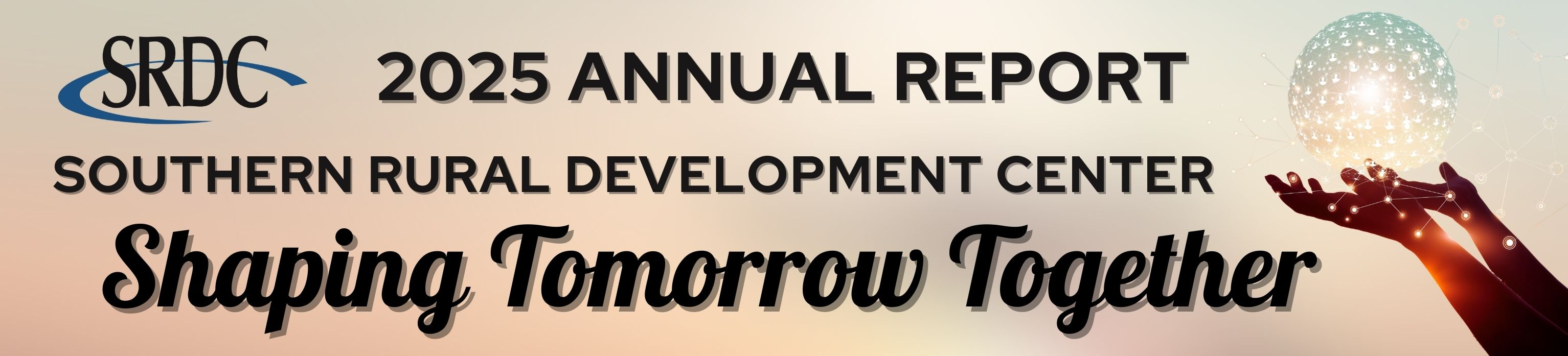
Southern Rural Development Center Releases 2025 Annual Report
Shaping Tomorrow Together
The Southern Rural Development Center (SRDC) has released its 2025 annual report, Shaping Tomorrow Together, highlighting the power of collaboration in advancing rural development. The report showcases how partnerships across organizations, institutions, and communities strengthen research and Extension efforts that respond to the evolving needs of rural America.
Through continued collaboration with the Land-Grant System, the U.S. Department of Agriculture’s National Institute of Food and Agriculture (NIFA), and numerous partners, SRDC is helping shape a more prosperous future for rural people and places. The report reflects both the impact of these collective efforts and SRDC’s commitment to strengthening research and Extension as enduring models of public service.
2026 Bonnie Teater Community Development Lifetime Achievement Award Nominations
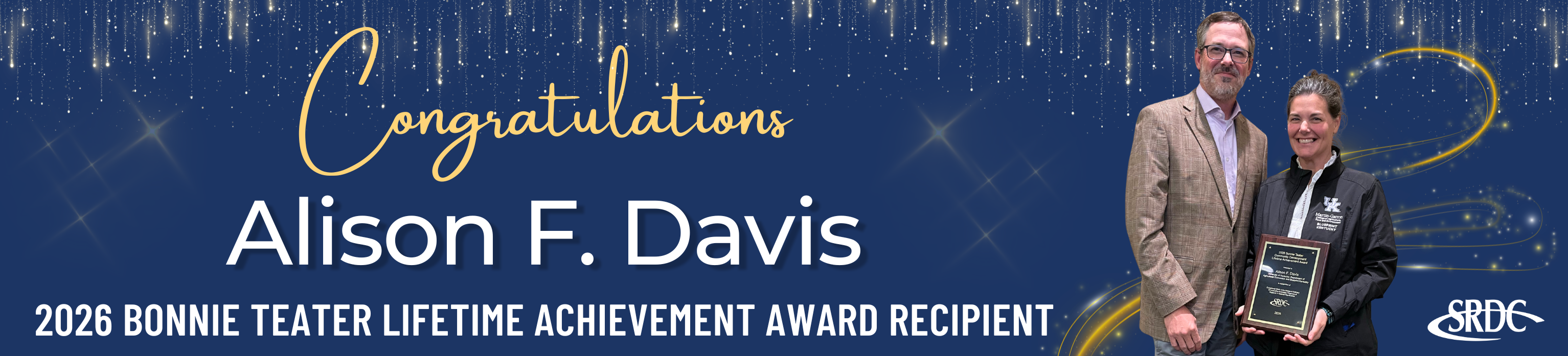
The Southern Rural Development Center is pleased to announce that nominations are being sought for the Bonnie Teater Community Development Lifetime Achievement Award for 2026. The instructions provided specify information regarding to this important award and the deadline date for nominations to be received. The award is for superior lifetime work by an individual (not a team) who has made an important contribution to the Extension Community Development area. The award consists of a plaque and a $500 stipend. The award is presented at the annual meeting of the National Association of Community Development Extension Professionals, and the awardee is featured on the SRDC’s website and annual report.
Understanding Heirs' Property at the Community Level: Good News Impact
In 2025, GMH Ministries, Inc. (Grandmama’s House) hosted four Understanding Heirs’ Property at the Community Level workshops across Metro Atlanta to educate residents about heirs’ property risks, property fraud, and prevention strategies.
Through this initiative, 74 participants attended and received direct education and referrals. As a result, 47 individuals were connected to legal assistance and eight received financial guidance. Collectively, these interventions represent an estimated $17 million in real estate value preserved, helping families protect their homes, stabilize neighborhoods, and preserve generational wealth. Participant feedback consistently described the workshops as informative, empowering, and impactful.
These workshops were financially sponsored by Local Initiatives Support Corporation (LISC) and delivered in partnership with Atlanta Legal Aid Society, McClendon Law & Consulting, Erramilli Law Group, TrueBlue Financials, and other trusted professionals.
GMH Ministries, Inc. is a Georgia-based 501(c)(3) community development organization dedicated to helping low-income seniors and families age in place with dignity, preserve generational wealth, and maintain housing stability. A core focus of our work is preventing the loss of family-owned land and homes through education, outreach, and early intervention around heirs’ property issues.
New Report Released: Broadband Access and Digital Case Studies Project
The recently released report, Broadband Access and Digital Skills Case Studies Project, shares how communities are turning broadband access into real-world impact. Land-grant universities and Cooperative Extension are guiding users from awareness to meaningful tech use through the Digital Access Continuum.
Upcoming INRPHA Webinar
Despair and Aging in Southern Appalachia: The Great Smoky Mountains Study
The Interdisciplinary Network on Rural Population Health and Aging (INRPHA) will host a virtual seminar titled “Despair and Aging in Southern Appalachia: The Great Smoky Mountains Study”.
Friday, February 13, 2026
10:00 a.m. Pacific | 11:00 a.m. Mountain | 12:00 noon Central | 1:00 p.m. Eastern.
The presentation will be delivered by William E. Copeland, Professor of Psychiatry, and Thomas M. Achenbach, Chair of Developmental Psychopathology at the University of Vermont. Dr. Copeland is widely recognized for his research on mental health across the life course, with a particular focus on long-term population-based studies. His work is supported by grants from the National Institute on Aging and the National Institute of Child Health and Human Development. He also serves as Vice President and Treasurer of the nonprofit Research Center for Children, Youth and Families, which develops and distributes mental health measurement tools.
This seminar will draw on findings from the Great Smoky Mountains Study to explore the intersections of despair, mental health, and aging in Southern Appalachia—offering important insights for researchers, practitioners, and policymakers working to improve population health in rural communities.
The event is hosted by the Interdisciplinary Network on Rural Population Health and Aging (INRPHA), which is funded by the National Institute on Aging (Grant 1R24AG089064) and led by Carrie Henning-Smith (University of Minnesota), Leif Jensen (Penn State), Shannon Monnat (Syracuse University), John Green (Southern Rural Development Center/Mississippi State University), and Lori Hunter (University of Colorado Boulder).
INRPHA webinars are open to all participants. Mississippi State University is an equal opportunity institution. To request an accommodation or for accessibility inquiries, please contact Carmen Kelly at carmen.kelly@msstate.edu.
Call for Papers: Special Issue on Rural Livability
Submission Deadline: March 15, 2026
The Review of Regional Studies invites submissions for a Special Issue on Rural Livability, guest edited by Steven Deller (University of Wisconsin-Madison) and Tessa Conroy (University of Wisconsin-Madison).
Across the United States and beyond, rural communities are shifting from a narrow focus on growth to a more holistic framework of place-making: strengthening the assets, institutions, and relationships that enhance quality of life and foster resilience. This special issue explores research, policy, and practice concerning all aspects of rural livability. We welcome both theoretical and empirical contributions examining how rural livability manifests across diverse regions and contexts. Topics of interest include, but are not limited to:
The role of community capitals (social, human, natural, physical, financial, and cultural) in shaping livability
Individual participation, civic engagement, and social innovation as drivers of rural vitality
Policy changes at the state or federal levels and their impact on rural well-being and development
Migration, demographic change, and workforce dynamics in rural communities
The intersection of livability, sustainability, and resilience in rural economies
Place-based policies for housing, infrastructure, broadband, and health care
Measurement and evaluation of rural livability across spatial and temporal scales
Extension, outreach, and community partnerships supporting local prosperity and inclusion
The impact of AI on rural communities
Submissions should be made through the Scholastic RRS portal under “Special Issue on Rural Livability”. Manuscripts should follow the Review of Regional Studies author guidelines available on our Author Instructions page. All papers will undergo a double-blind peer review process.
For questions regarding this special issue, please contact Guest Editor, Dr. Steven Deller, at scdeller@wisc.edu. For questions regarding the Review of Regional Studies, please contact journal editor, Dr. Yong Chen, at Yong.Chen@oregonstate.edu.
About RRS: The Review of Regional Studies (ISSN 0048-749X) publishes high-quality theoretical and empirical social science research in which the spatial dimension plays a fundamental role. The journal is the official publication of the Southern Regional Science Association and provides an open-access platform for interdisciplinary scholarship that informs regional policy and practice.
For more information and to submit a manuscript.
Requests for Proposals: Interdisciplinary Network on Rural Population Health and Aging (INRPHA)
We are delighted to share the latest request for INRPHA pilot grant proposals.
Request for Pilot Research Proposals
Due Date: Friday, April 10, 2026, at 5 p.m. CT/6 p.m. ET
With funding from the National Institute on Aging (NIA), the Interdisciplinary Network on Rural Population Health and Aging (INRPHA) invites investigators to submit proposals for pilot research that enhances understanding of the multilevel and multidimensional drivers of rural health and aging trends and disparities, with emphasis on within-rural heterogeneity. INRPHA seeks proposals that will advance science in this important area and that will lead to fundable NIH grant proposals. Pilot projects will begin as early as July 1, 2026.
Direct questions to the INRPHA PI, Carrie Henning-Smith, at henn0329@umn.edu.
INRPHA is funded by NIA grant 1R24AG089064 and led by Carrie Henning-Smith (University of Minnesota), Leif Jensen (Penn State), Shannon Monnat (Syracuse University), John Green (Southern Rural Development Center/Mississippi State University), and Lori Hunter (University of Colorado Boulder).