





Download
Items of Interest
SRDC Director John J. Green Appointed Community Development Research Fellow with Federal Reserve Bank of St. Louis
Dr. John J. Green, director of the Southern Rural Development Center (SRDC) at Mississippi State University and Professor in the Department of Agricultural Economics, has been named a Community Development Research Fellow with the Federal Reserve Bank of St. Louis. The St. Louis Fed is part of the Federal Reserve System’s network of regional Reserve banks that help promote a healthy U.S. economy.
As part of the fellowship, Dr. Green will engage with the Federal Reserve Bank of St. Louis’ Community Development department, which conducts research and shares insights on economic conditions and mobility affecting households and communities across the Eighth Federal Reserve District and beyond. More information about the department and its staff is available through the online directory.
Reflecting on this opportunity, Dr. Green noted the value of collaboration across institutions. “I look forward to working with colleagues at the Federal Reserve Bank of St. Louis,” he said. “This fellowship provides a meaningful avenue for contributing to research and discussions that can inform community development efforts throughout the region.”
The fellowship program includes scholars from a variety of fields, such as sociology, economics, political science, social work, and psychology. Dr. Green, a rural sociologist and demographer, focuses his research on rural development, population change, and the factors shaping the well-being of rural communities.
During his fellowship, Dr. Green will collaborate with Community Development staff and partners, author and co-author research publications, participate in seminars, and present findings related to community and economic development.
Green’s work aligns with the SRDC’s mission to connect universities with community, state, and national organizations to advance research-informed approaches that support rural prosperity. His engagement with the St. Louis Federal Reserve will further contribute to these ongoing efforts.
For more on Mississippi State University’s Southern Rural Development Center, visit https://srdc.msstate.edu.
Understanding Heirs’ Property at the Community Level: Good News Impacts
As an Understanding Heirs’ Property at the Community and Advanced Level trainer, Associate Specialist of Small Farms, Jackson Jamerson of Southern University’s Agricultural Research and Extension Center focuses on helping farmers, landowners, and rural families understand how heirs’ property issues affect land ownership, agricultural production, and long‑term land retention.
Recently, Jamerson facilitated a small, community‑based discussion with a group of farmers in a home setting to walk through heirs’ property basics, succession planning, and practical next steps for protecting family land. He also presented this information to producers and ranchers at the Louisiana Cattlemen’s Association conference, where he outlined how unclear land titles can limit access to loans, conservation programs, and agricultural opportunities.
His efforts continue to increase awareness, encourage proactive planning, and connect participants to trusted legal and Extension resources that support long-term land stability.
2026 Bonnie Teater Community Development Lifetime Achievement Award Nominations
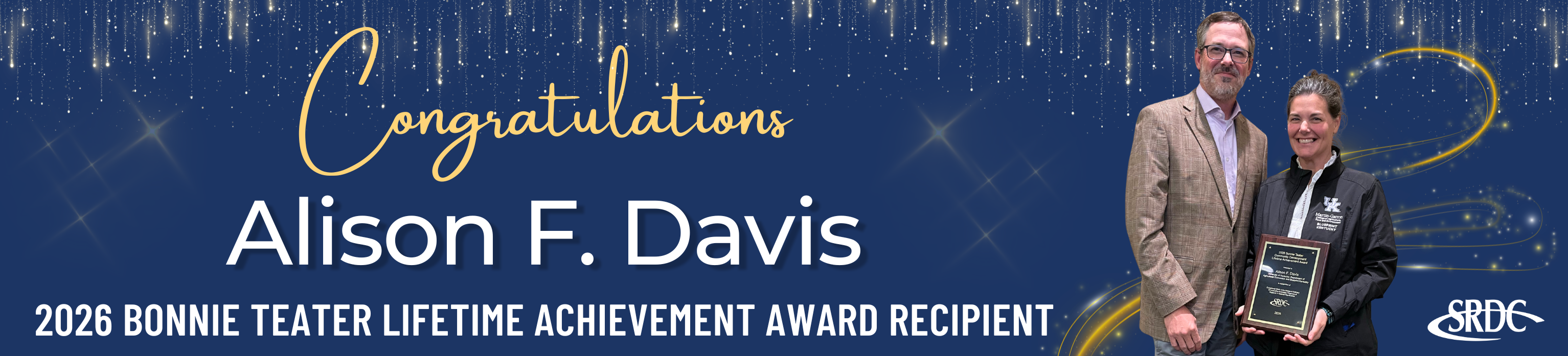
The Southern Rural Development Center is pleased to announce that nominations are being sought for the Bonnie Teater Community Development Lifetime Achievement Award for 2026. The instructions provided specify information regarding to this important award and the deadline date for nominations to be received. The award is for superior lifetime work by an individual (not a team) who has made an important contribution to the Extension Community Development area. The award consists of a plaque and a $500 stipend. The award is presented at the annual meeting of the National Association of Community Development Extension Professionals, and the awardee is featured on the SRDC’s website and annual report.
Collaborative Impact: Advancing Rural Communities through PROPEL
The PROPEL initiative continues to demonstrate the power of collaboration in advancing rural and underserved communities across Louisiana. At the 2025 Louisiana Land-Grant Agriculture Summit, representatives from Southern University Agricultural Research and Extension Center (SUAREC) and the LSU AgCenter delivered a joint presentation titled “Collaborative Impact: Strengthening Rural Communities through the PROPEL Program in Ville Platte and Lake Providence, Louisiana.” The session highlighted how intentional partnerships between 1862 and 1890 Land-Grant Institutions can drive meaningful, community-centered outcomes.
The presentation underscored the importance of SUAREC and LSU AgCenter working collaboratively to leverage complementary strengths, shared expertise, and trusted local relationships. Through PROPEL, both institutions have aligned resources to address long-standing economic, workforce, and infrastructure challenges while ensuring that community voices remain central to the development process. This 1862–1890 collaboration exemplifies how Land-Grant systems can move beyond parallel efforts toward integrated, impact-driven programming.
A key component of PROPEL’s work involves providing targeted technical assistance to rural communities seeking funding opportunities through the Delta Regional Authority (DRA). PROPEL teams conducted structured community listening sessions in Ville Platte and Lake Providence to gather qualitative and quantitative data directly from residents, local leaders, and stakeholders. These sessions helped identify priority needs, capacity gaps, and locally defined solutions, strengthening the foundation of DRA grant applications and ensuring alignment with community identified goals.
In addition to data collection, PROPEL provided hands-on grant preparation assistance, supporting communities in translating their priorities into competitive proposals.
Call for Papers: Special Issue on Rural Livability
Submission Deadline: March 15, 2026
The Review of Regional Studies invites submissions for a Special Issue on Rural Livability, guest edited by Steven Deller (University of Wisconsin-Madison) and Tessa Conroy (University of Wisconsin-Madison).
Across the United States and beyond, rural communities are shifting from a narrow focus on growth to a more holistic framework of place-making: strengthening the assets, institutions, and relationships that enhance quality of life and foster resilience. This special issue explores research, policy, and practice concerning all aspects of rural livability. We welcome both theoretical and empirical contributions examining how rural livability manifests across diverse regions and contexts. Topics of interest include, but are not limited to:
The role of community capitals (social, human, natural, physical, financial, and cultural) in shaping livability
Individual participation, civic engagement, and social innovation as drivers of rural vitality
Policy changes at the state or federal levels and their impact on rural well-being and development
Migration, demographic change, and workforce dynamics in rural communities
The intersection of livability, sustainability, and resilience in rural economies
Place-based policies for housing, infrastructure, broadband, and health care
Measurement and evaluation of rural livability across spatial and temporal scales
Extension, outreach, and community partnerships supporting local prosperity and inclusion
The impact of AI on rural communities
Submissions should be made through the Scholastic RRS portal under “Special Issue on Rural Livability”. Manuscripts should follow the Review of Regional Studies author guidelines available on our Author Instructions page. All papers will undergo a double-blind peer review process.
For questions regarding this special issue, please contact Guest Editor, Dr. Steven Deller, at scdeller@wisc.edu. For questions regarding the Review of Regional Studies, please contact journal editor, Dr. Yong Chen, at Yong.Chen@oregonstate.edu.
About RRS: The Review of Regional Studies (ISSN 0048-749X) publishes high-quality theoretical and empirical social science research in which the spatial dimension plays a fundamental role. The journal is the official publication of the Southern Regional Science Association and provides an open-access platform for interdisciplinary scholarship that informs regional policy and practice.
For further information and to submit a manuscript
Missed it Live? The Latest INRPHA Webinar is Now Available
Despair and Aging in Southern Appalachia: The Great Smoky Mountain Study
This seminar draws on findings from the Great Smoky Mountains Study to explore the intersections of despair, mental health, and aging in Southern Appalachia—offering important insights for researchers, practitioners, and policymakers working to improve population health in rural communities.
Presenter: William E. Copeland, PhD, Professor of Psychiatry, and Thomas M. Achenbach, Chair of Developmental Psychopathology at the University of Vermont.
Dr. Copeland’s work is funded through grants from the National Institute on Aging and the National Institute of Child Health and Human Development. He also receives funding as Vice President and Treasurer of the nonprofit organization Research Center for Children, Youth and Families which develops and distributes measures of mental health. The Interdisciplinary Network on Rural Population Health and Aging (INRPHA) is funded by the National Institute on Aging grant 1R24AG089064 and led by Carrie Henning-Smith (University of Minnesota), Leif Jensen (Penn State), Shannon Monnat (Syracuse University), John Green (Southern Rural Development Center/Mississippi State University), and Lori Hunter (University of Colorado Boulder).
Requests for Proposals: Interdisciplinary Network on Rural Population Health and Aging (INRPHA)
We are delighted to share the latest request for INRPHA pilot grant proposals.
Request for Pilot Research Proposals
Due Date: Friday, April 10, 2026, at 5 p.m. CT/6 p.m. ET
With funding from the National Institute on Aging (NIA), the Interdisciplinary Network on Rural Population Health and Aging (INRPHA) invites investigators to submit proposals for pilot research that enhances understanding of the multilevel and multidimensional drivers of rural health and aging trends and disparities, with emphasis on within-rural heterogeneity. INRPHA seeks proposals that will advance science in this important area and that will lead to fundable NIH grant proposals. Pilot projects will begin as early as July 1, 2026.
Direct questions to the INRPHA PI, Carrie Henning-Smith, at henn0329@umn.edu.
INRPHA is funded by NIA grant 1R24AG089064 and led by Carrie Henning-Smith (University of Minnesota), Leif Jensen (Penn State), Shannon Monnat (Syracuse University), John Green (Southern Rural Development Center/Mississippi State University), and Lori Hunter (University of Colorado Boulder).
Job Postings
Administrative Assistant I, Southern Rural Development Center
The Administrative Assistant I position, is a full-time position located on the campus of Mississippi State University.
This position supports the daily operations of a busy office by coordinating schedules, managing workflow, and helping streamline administrative processes. The role also assists with data collection, report preparation, and communication across the department to keep operations running smoothly. Candidates must have a high school diploma and four years of related experience, with preferred qualifications including a bachelor’s degree in business or accounting and experience with fund accounting.
Access more information and the application for the Administrative Assistant I position with SRDC.
Editor/Co-Editor, Local Development and Society Journal
The journal Local Development & Society (LD&S) was launched in 2020 as a partnership between the Community Development Society and Taylor and Francis (also branded as Routledge). The journal will begin its 7th year of production with the editing process managed by Rhonda G. Phillips, Ph.D. and Norman Walzer, Ph.D. as founding co-editors with Sofia Kotsiri, Ph.D. as managing editor. LD&S operates independently from Community Development and publishes 3 issues per year with an average of 10 articles per issue. It also publishes book reviews with Josh Newton, Ph.D., serving as book review editor along with commentaries that are reviewed by the editorial team. LD&S has an editorial board of 16 members located in five countries.
View more information about the journal, the position responsibilities, and access the application.